I build the system your business runs on.
 Beyker Estrada
Notion, built around how your work moves and wired to the tools you already pay for. Every build gets documented and handed to someone on your team who can run it without me.



The same four problems, every time.
This is what I see most in service businesses, from five people to a couple of hundred, usually the ones where one person is still the last stop for everything.
What people hire me to build.
The audit decides which of these you need. Most builds are two or three of them, not six.
Client portals
Clients see their own work without getting into your workspace.
CRM and pipeline
Deals and contacts connected to the delivery work they turn into.
Project and delivery
Intake to handoff in one place, with capacity you can see before you say yes.
Cross-tool automation
Notion talking to Slack, Sheets, Salesforce and whatever else you already pay for.
AI agents
Meeting notes written to the right page. Records that update themselves.
Migration and cleanup
Out of Asana, Monday, ClickUp or spreadsheets, with the data cleaned instead of dumped.
- Documentation, always
- Your team trained to run it
- 30 days of support
- Fixed scope, fixed price
Two builds, start to finish.
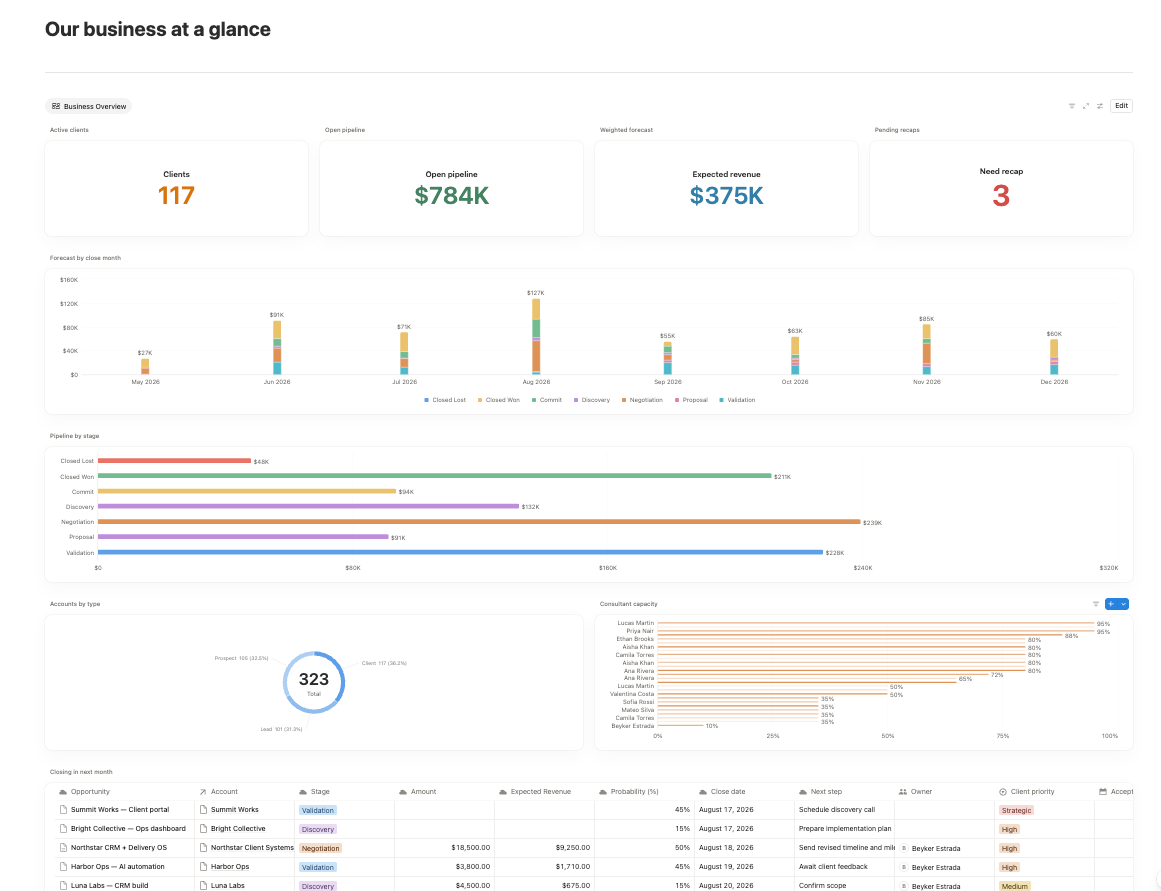
An AI-Powered Knowledge & Sales System for BK Consulting
Knowledge lived in HubSpot, Fathom and Slack, and none of them agreed. One Notion workspace now holds it, and the sales pipeline and project handoff run off the same records.
Read the case study →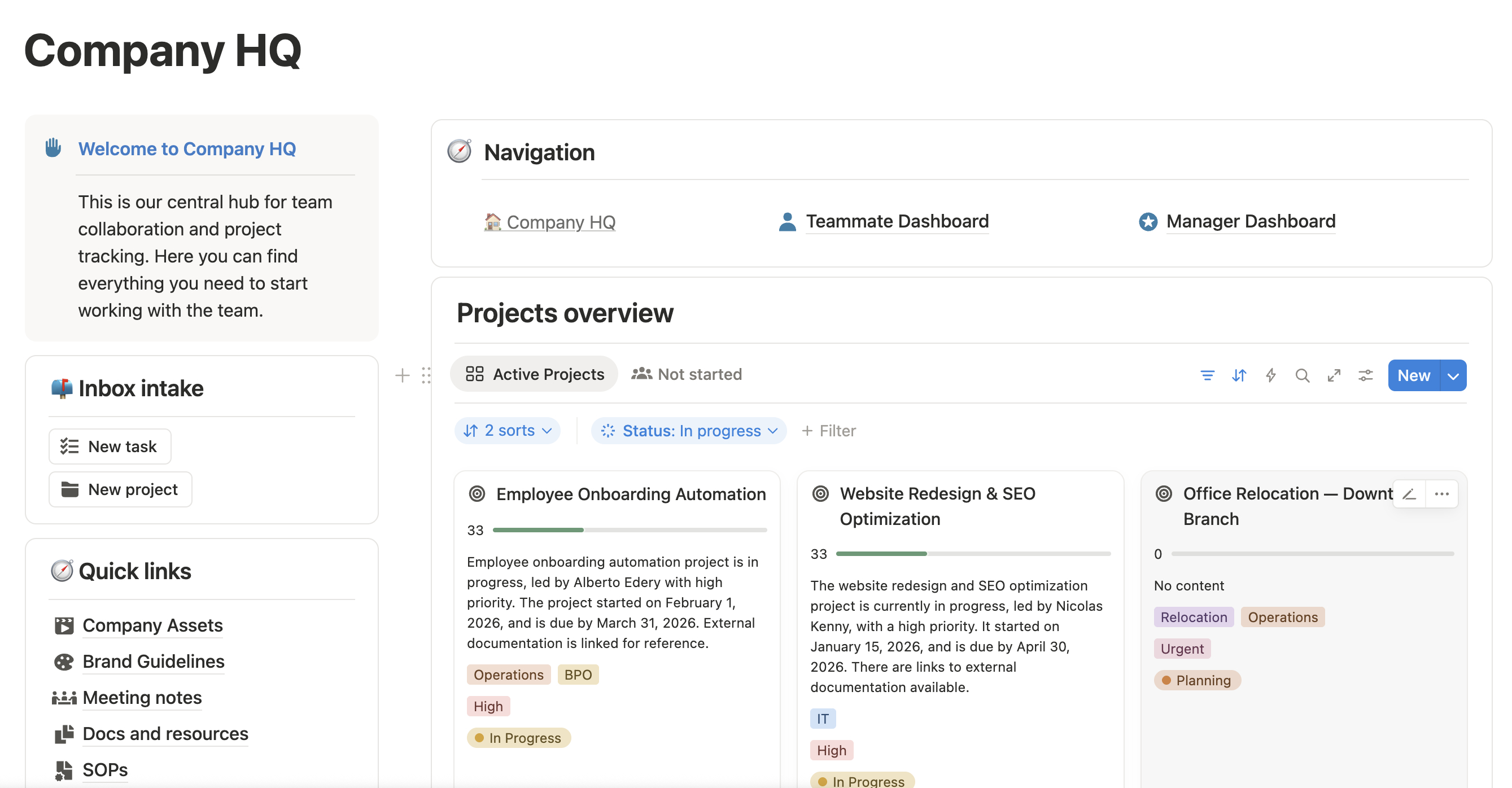
Operations System & Automation for a Real Estate Professional
Client follow-ups depended on one person remembering them. Now intake, communication and the recurring work all run out of one workspace, and the follow-ups fire on their own.
Read the case study →“Beyker didn't just configure tools. He mapped out systems and processes so I could hit the ground running from day one. He's exceptionally resourceful, whether building direct integrations or finding creative workarounds when standard connections don't exist. He takes feedback seriously, iterates quickly, and isn't satisfied until everything actually works the way you need it to.”
“I especially value his ability to understand real needs, propose practical improvements, and turn complex processes into simple, usable systems. Thanks to his work, I achieved greater organization, focus, and efficiency in my day-to-day work.”
“He has a genuine passion for understanding and helping people, and a level of commitment to each project he touches that is hard to find today. His attention to detail gives the team great peace of mind, because you know that issues will be well resolved.”
“When we began working with Beyker, we realized that we shared the same values around innovation and continuous improvement. He is a valuable partner who helps us achieve our goals.”
Hi, I’m Beyker Estrada.
I spent years on the customer side of the table, as the person people came to when something wasn’t working. That job taught me that customers don’t care how a system works, only that it does, and that the simplest version of anything is usually the one that survives contact with real use.
I started using Notion in 2020 for my own work, liked it enough to start building templates, and was taking client work by 2022, before I was certified. The certification came after, to check that what I was already doing held up.
Today I run Beyker Estrada Consulting out of Santiago, with a small team behind me. You work with me start to finish, and I stay the one accountable for the result.

I became a polyglot by accident. Portuguese came from practising Capoeira, French from listening to Stromae. Italian and Japanese are next.
I can solve a Rubik’s cube in under 57 seconds (for now)
I live in Chile and there is a beer brand here called Becker. People call me that sometimes.
I do my best thinking on long walks, which is why most of my build decisions get made away from the laptop.
How I work.
I start with the problem rather than the request. When someone asks me for a project tracker, my first question is what happens before a project starts and what breaks after it ends, because the answer is usually where the real work is.
That makes me slower to start and a lot faster to finish. It also means I will sometimes tell you the thing you asked for isn’t worth building.
What I believe about systems.
A good system reduces what your team has to hold in their heads. If people have to remember to update something, log it somewhere, or go and check, the design failed.
So I build for interconnection, one piece of information typed once and showing up everywhere it matters. I have also watched plenty of over-engineered workspaces die. Complexity looks impressive in the demo and becomes a burden by month two, so I default to the smallest thing that solves the problem.
What I turn down.
Five kinds of project I say no to. If yours is one of them, say so on the call and we both save the time.
If you have already decided exactly what you want built and don’t want a conversation about the problem underneath it, we will both be frustrated. The marketplace has good templates and I will point you at one.
Audits are always paid. There is no version of this where I build something to prove I can build things.
This comes up on the free call more often than people expect. If what you need is a real CRM, a real ERP or a real database, I say so and I don’t take the money.
Inheriting someone else’s architecture costs more than starting clean, and nobody believes that until we are three weeks in. If you want a second opinion on whether it is salvageable, that is an audit.
If nobody on your side will hold the system after I leave, it dies in about six weeks and it ends up looking like my fault. I would rather move your start date than deliver into a vacuum.
Every number, before you call.
Let’s talk about what’s broken.
I ask what is going on and how your team works day to day. You ask me whatever you want. Bring the process that annoys you most.
Pick a time that works.
Opens my live calendar. Take any open slot, no back and forth over email.
Book a free callBook it directly and we use the hour properly, instead of spending fifteen minutes deciding to spend an hour.
Book the $250 audit