One system your business actually runs on.
Notion designed around how your work really moves, automated where it matters, documented so your team keeps it running after we hand it off.
Six things people ask for most.
Client portals
Give clients a view of their work without giving them your workspace.
CRM and pipeline
Deals, contacts, and revenue connected to the delivery work they turn into.
Project and delivery
Intake to handoff in one place, with capacity you can actually see.
Cross-tool automation
Notion talking to Slack, Sheets, Salesforce, and whatever else you already pay for.
AI agents
Meeting notes written to the right page. Records that update themselves.
Migration and cleanup
Out of Asana, Monday, ClickUp, or spreadsheets, with the data cleaned instead of dumped.
What’s in every build.
The size changes. These don’t.
- A data model that maintains itself. Relations and rollups so information is entered once.
- Automations for the steps a person shouldn’t be doing. Native Notion or n8n, whichever fits.
- Your existing data migrated in, cleaned rather than dumped.
- Written documentation covering how it works and how to extend it.
- Training for whoever will own it on your side.
- 30 days of support after handoff.
How it goes.
Free call
Fifteen minutes. I tell you whether Notion is the right answer. Sometimes it isn’t.
Systems audit
One hour inside your process. Written report, recommendation, and a quote in 72 hours.
Build
Two to six weeks. Fixed scope, fixed price, progress you can see every week.
Handoff
Documentation, training, and 30 days of support. Then it’s yours.
“Will my team actually use it?”
This is the question we get most, and it’s the right one. Most Notion rollouts die around six weeks in, when whoever set it up stops maintaining it and everyone quietly goes back to spreadsheets.
So we plan for it from the start. Every build includes documentation and a trained owner on your side, someone who can use the system, teach it, and fix it when something breaks. We don’t send the final invoice until that person exists.
- The audit report lands within 72 hours of our call
- You see progress every week during a build
- Every build is documented before handover
- No final invoice until your team can run it without outside help
- If Notion is the wrong tool, I say so and don’t take the project
- Fixed scope, fixed price. Anything added mid-build is quoted before work starts on it
Questions.
Because quoting a system we haven’t looked at means guessing, and guessing means either you overpay or we eat the difference. An hour inside your workspace turns a guess into a fixed price.
It depends on the size of the problem, which is what the audit establishes. You get a fixed price in writing within 72 hours of the audit call, along with our recommendation and what we’d leave out. Nothing starts until you’ve agreed to it.
Between two and six weeks depending on scope. You see progress every week rather than a reveal at the end.
It gets quoted separately before we do any of it, and you decide. The original scope stays at the original price.
Whichever is cheaper for you, and the audit says which. Sometimes a rebuild costs less than untangling what’s there. We’ll show you the reasoning either way.
We talk about whether an ongoing arrangement makes sense. No obligation, no auto-renewal on anything.
Recent work.
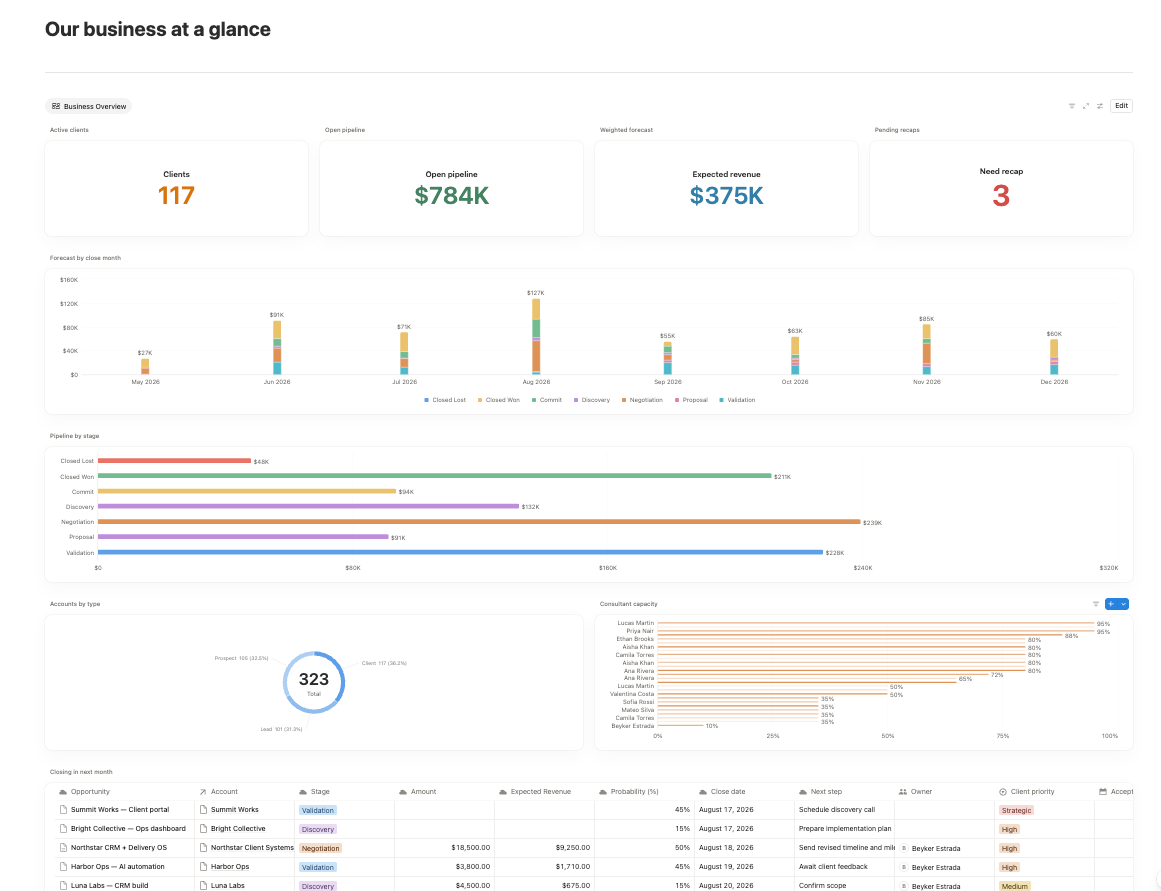
An AI-Powered Knowledge & Sales System for BK Consulting
Knowledge scattered across HubSpot, Fathom, and Slack. One AI-connected Notion workspace now runs knowledge management, the sales pipeline, and project handoff end to end.
Read the case study →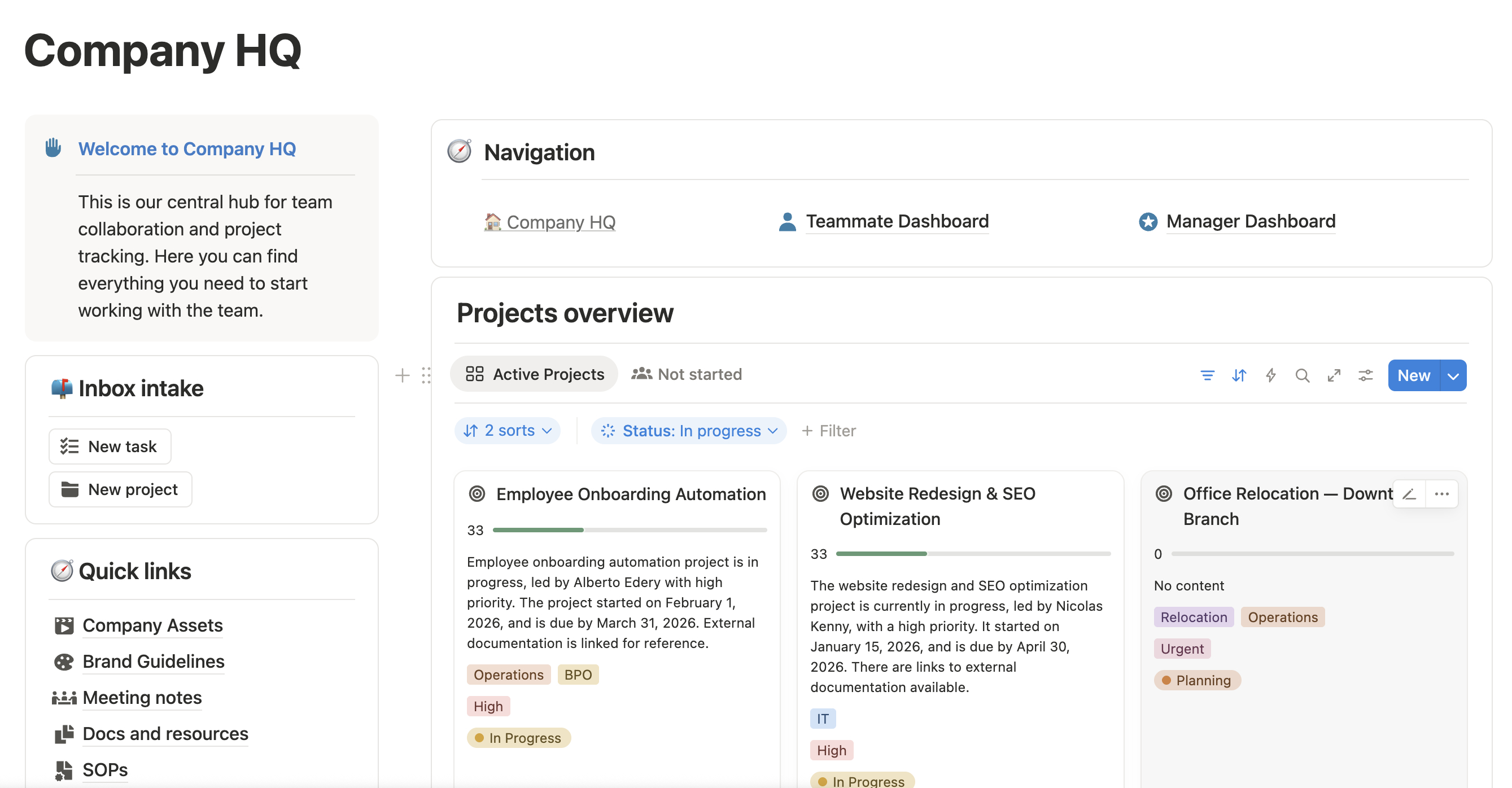
Operations System & Automation for a Real Estate Professional
Client communication, follow-ups, and recurring operations lived across scattered tools. One centralized workspace now runs the business day to day.
Read the case study →“Beyker didn't just configure tools. He mapped out systems and processes so I could hit the ground running from day one. He's exceptionally resourceful, whether building direct integrations or finding creative workarounds when standard connections don't exist. He takes feedback seriously, iterates quickly, and isn't satisfied until everything actually works the way you need it to.”
“I especially value his ability to understand real needs, propose practical improvements, and turn complex processes into simple, usable systems. Thanks to his work, I achieved greater organization, focus, and efficiency in my day-to-day work.”